Showing posts with label face. Show all posts

Tuesday, July 14, 2009

Bee Sting Therapy


Bee venom therapy is the part of apitherapy which utilizes bee venom in the treatment of health conditions.

Apitherapy is the use of beehive products, including honey, pollen, propolis, royal jelly, bee venom.

It has been used since ancient times to treat arthritis, rheumatism, back pain, skin diseases and in this modern age as an alternative therapy to treat multiple sclerosis, Lyme disease and chronic fatigue syndrome. Bee venom comes from the stingers of honey bees who use it in defense of the bee colony.

Bee venom is a rich source of enzymes, peptides and biogenic amines. There are at least 18 active components in the venom which have some pharmaceutical properties. The effect mechanism of the venom is not entirely know yet.

Scientists believe it can modify the way the immune system functions in the body and contribute to increased cortisol production.

Traditionally, bee venom was administered with live bees by stimulating them to sting in the affected area, trigger points or acupuncture points.

Depending on the nature of the disease, the standardized venom can be used in a cream, liniment, ointment or injection form.

Bee venom is most effective when it comes directly from the live bee during the late spring to early fall season when bees have a good pollen source to produce potent venom.

Their venom during the winter period is less potent. Next to the effect of a live bee, injectable venom solution is considered to be a standard method to administer bee venom.

Venom solution is prepared from pure bee venom (Apis Venenum Purum) and is a homeopathic preparation. It is administered intradermally just between the skin layers or subcutaneously under the skin to imitate the effect of a bee sting.

Each injection is equivalent to or is less than the average dry venom sac content of a honey bee. Bee venom is also used topically in creams, liniments and ointments.

The application of venom solution with electrophoresis or ultrasonophoresis is practiced in Europe and China.

Tuesday, May 26, 2009

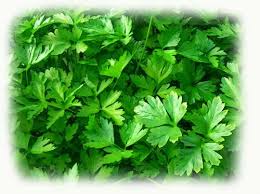
Parsley For Your Skin


Parsley contains a high concentration of vitamin C, iron and is a good source of manganese. It also contains calcium and is a great source of potassium.

The benefits these vitamins and minerals have on your skin is well know.

Vitamin C is a powerful anti-oxidant and in conjunction with protein, is necessary for the production of collagen - the glue that holds us and our skin together and circumvents sags or wrinkles.

It regulates sebaceous glands to keep skin from drying out; helps prevent facial lines, wrinkles and spider veins.

The use of Parsley is not restricted to culinary applications. Sure, parsley is a common ingredient in sauces, soups, rissoles, mince and salads, etc., however, parsley also has medicinal applications.

Herbalists may choose to use parsley in their treatment approach to dysmenorrhoea, amenorrhoea, as a diuretic, anti-flatulent and/or to stimulate appetite.

Other constituents found in Parsley The essential oil comprising apiol, apiolin, myristicin, pinene. In addition to the ingredients listed earlier, parsley also contains flavonoids, a glucoside, apiin, and pro-vitamin A.


Friday, February 13, 2009

Red dots on my skin...


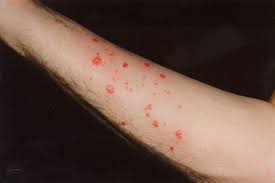
Over the past year, I have been getting red dots on my skin.
They are not raised and not itchy --> but they are bright red and increasing in number.

They are mainly on my upper arms and chest, but I do have some on my thighs, lower arms, and neck.

I went to a dermatologist who said that they were nothing to worry about and no one knew the cause. I am nervous about this diagnosis because these red dots just keep coming!

Someone suggested that it could be a problem with my blood. I found a couple of articles on it -- but I am hoping that people here can share their personal experiences and advice with me.

I'm going to my doctor soon to get a referral to a hematologist... but in the meantime, I can't help but wonder what could be wrong with me and how they will diagnose it!

Thanks for sharing any experience or advice.

Thursday, December 25, 2008

Pimples ? Wash your face !!


I don't know if you got rid of your acne by now.

I'm 35, i've had acne since 15, and nothing works eighter.

Best recommandation : wash your face ALL the time.

Your face should normally be oily.

You don't want that oil, just wash it away when it appears, and things should be a little better, but not perfect.

Saturday, November 8, 2008

Young skin tips


Your skin mirrors your lifestyle.

It reflects what you eat, drink or do.

So invest on your skin - keep it young with these simple lifestyle pointers.

Drink Plenty of Water - This aids in the elimination of wastes and toxins from the skin.
Adults need 1 to 1.5 liters of water a day.

Sleep - Get enough of it.
Skin renewal occurrence increases when you sleep. Tiredness deprives skin of the energy needed to recover and regenerate.

Frowning causes worry lines and constant stress emits negative energy to the skin.
For stress-relief, treat yourself to yoga classes, massages, or even a leisurely spa session.
For a quick fix, try lying down face up, close your eyes, and feel the muscles in your face relax. Do this for 60 seconds every time you feel the tension in your facial muscles.

Wednesday, August 13, 2008

One-hour facelift ?


"One hour face lift" is a marketing term for a mini lift which is designed primarily for superficial tightening.

It generally does not tighten the muscles nor the undermine the SMAS.

Thus, it does not last as long or provide as much improvement as a traditional face lift (also known as modern facelift).

With continual refinement of the traditional facelift technique, healing and costs have dramatically improved.

Thursday, May 22, 2008

Can massaging the skin on the face and neck cause damage?


There are two layers of skin; the dermis and the epidermis.
Then there is another layer under these, called the subcutaneous layer.
All these layers together are essentially the thickness of typing paper on the face.
This subcutaneous layer also contains fat.
It's often called the subcutaneous layer of fat.

If you pinch and roll this layer you can actually break it down, causing damage.

Instead, you can gently work the face through massage and exercise, keeping in mind that "gentle" is the key word here and something miraculous happens.

But first a little talk about how the muscles attach in the body and in the face.

Muscles do attach from bone to bone in the body, essentially and from the bone directly into the skin on the face.

In the western culture where we show a lot of emotions on our face and therefore habitually create expression, we tend to create lines on our faces.

We are not creating lines in the muscles, but rather we're creating lines in this subcutaneous layer.. the analogy being as if you were to "score" cardboard… we tend to "score" this subcutaneous layer and the lines are created as we repeat a particular expression over and over again.

BeautyLight Light Therapy Face Lift :